Showing posts with label Recession. Show all posts

Saturday, March 21, 2009

US births break record; 40 pct out-of-wedlock


US births break record; 40 pct out-of-wedlock

I read this on Yahoo the other day (well, March 18 to be precise).

The graph rather impressively shows that in 2007 we had more births than even in the post World War II decade.

The article states: "On average, a U.S. woman has 2.1 babies in her lifetime. That's the "magic number" required for a population to replace itself."

Of course, I thought of my Harry Dent post because he said the same thing about the 2.1 babies per children. I had it "per family" but it makes more sense "per woman" until men start having more babies anyway. Which leads to an entirely new line of thinking about how the family should follow women given their singular ability. But I'll leave that line to another day.

The article further states that 2007 was probably the 2nd year of a "boomlet" and I suppose if it goes on as long as the other one it grows up into a "boom."

I wonder what the recession does to birth rates? First answer that comes to mind is that it should decline because of uncertain financial means. But I bet it goes up. We humans seem to use most any occasion as a reason to procreate and I suspect recession is just as good as a power blackout. (Thinking that people will be more alone with each other and not going out as much maybe?)

Thursday, March 12, 2009

Tipping, Windmills, and Recession

I was thinking about the practice of tipping - you know, when you give additional money for a service performed.

At restaurants I always tip. Even if the service is lousy I usually tip. I think it may be because I've known a few people who were servers at restaurants and I know how much they depended upon tips. So I tip at restaurants.

But this is a little different.

Starbucks is a place I go nearly every morning. Usually I go inside. And usually it is about the same time of day and I usually order the same thing. So every morning I see the same people and I've learned their names.

They know my name but that is not unusual at my Starbucks. They know an amazing number of the names of the customers that come in about the same time that I am there. Usually I am there about an hour. That's how long it takes me to read the paper. It arrives electronically on my Kindle 2 and I read all of the stories except the sports section. So while I am reading the paper I am watching and listening and it amazes me how many people are known by either their name or their drink. Usually it is by name and drink. That would disqualify me from working at a Starbucks.

It is pleasant for me sitting at Starbucks and drinking my coffee and reading my paper and listening to the music as well as the conversations of both the customers and the staff. It is one of those places where you can go and be alone and yet have company at the same time so you don't feel lonely.

I used to do that very thing when I was caregiving. It was the place I went just before I returned home on Saturday mornings to take up my caregiver role again. I never really understood why I enjoyed it so much back then.

A few weeks ago one of the Baristas that I knew by name and had visited regularly was missing. I asked about her because she had shared with me that she was getting a Kindle 2. She took another job because her pay had been reduced by Starbucks corporate. I understand the need for the company to do that and I do not criticize them for it at all. I've had to make such decisions myself. Sometimes it is hard to know what to do and even harder to do it.

But that's when I decided to increase my tips.

It was my small, personal plan to fight the recession.

I recognize it is a mostly futile and foolish gesture on my part. I am Don QuiFlinty tilting at my own windmills.

After all what can one little guy adding a little to his tips do against the worst recession in 80 years compared to the trillions of dollars being spent by the government.

Not much I am sure.

But it makes me feel a little better every time I put a little more money in that Starbucks tip jar.

Tuesday, March 3, 2009

Economy

I think the fundamental problem is that there is an excess of just about everything. There is too much credit and too many houses and too many cars and too many stores and too many restaurants and on and on.

In a way there is too much because we have been too successful. I had this friend once who lived in another country. We shared a few pictures and one I sent him was of my son's home. My friend wrote me back asking if all of us in Oklahoma lived so luxuriously. My son's home at the time was very nice but would not be considered luxurious by any means. But that exchange made me think about how much we take for granted about how we live.

Then there is political influence. We have a mixed economic system. There is surely market forces at play but there is also political pressure.

And there is greed and corruption and lust and all the other vices with which we humans are afflicted.

But it is a system and like all systems it seeks equilibrium.

I think we are in one of those really out of balance periods now. The excess is going to have to be absorbed and purged. Credit is undergoing rapid balancing right now. The credit producers that survive will be better. But not all will survive.

There are too many cars and too much capacity for making cars and selling cars and most everything else about cars. Change is underway. There will be fewer cars and less capacity when the process is over.

There are too many houses but the excess will be absorbed eventually. In the meantime that industry will change.

There are too many stores but soon there won't be.

It is not a pain free process. It is not an instant process either.

The government can help make things easier and even attempt to point things one way or another. I personally think that government action will not really change the process that much either for good or bad.

And personally I would just as soon not have to go through all this at all. I don't like going through tornadoes either. But they just are and I have no choice about it.

When the process is over then we will already be in the process of building new things to excess. Maybe it will be electric cars or hydrogen fuel cells or some new kind of nanotechnology material or machines or whatever. Maybe we'll have too many Kindles and Net books. I don't know what but I know we'll make too many.

And about 70 years from now we'll go through this all again. Well I won't but my grandchildren will.

That's what I think.

Thursday, February 19, 2009

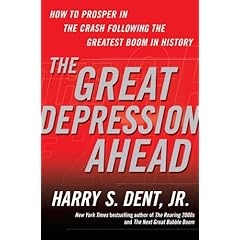
Book: The Great Depression Ahead: How to Prosper in the Crash Following the Greatest Boom in History - Part II

The Great Depression Ahead: How to Prosper in the Crash Following the Greatest Boom in History
By Harry S. Dent

I blogged about this book when I began reading it the other day.

Since then I finished reading the book, attended a lecture by the author, and discussed his ideas with others at some length.

Dent's premise is that economies are people spending money and that economic performance can be predicted based on how many people are in the economy, how old they are, where they live, and what they are buying. And the last two are largely dependent upon the first two.

So he believes that the United States baby boom population has now moved beyond the peak in maximum spending. He bases this on statistical research but also offers several possible reasons to explain it including the need to save for retirement, fear of economic uncertainty, downsizing, adopting slower life styles, and so on.

As an example he discussed the statistic that people buy their largest house at age 41. The friend and I who attended the presentation looked at each other and smiled because we were both that age when we built our largest homes. Dent showed a graph that plotted the age of Harley-Davidson buyers and it startling how sharply the graph shot up and just as sharply shot down.

I don't really like learning that my own buying habits are so predictable. I like to think of myself as being unique. And, yes, it is nearly hysterically funny that all of my group believe themselves to be just as unique. So even in that we are the same!

Now since all these baby boomers are now spending less and saving more it stands to reason that all the stuff we were buying is going to also decline unless someone else comes along to buy the same stuff.

But the people that will come along and will buy at least some of the same stuff are about 20 or more years away. And since they are our kids they will not buy exactly the same stuff as their parents just as we did not buy the same stuff bought by our parents.

So in Dent's discussion the good part is that there is another group coming up behind us in the United States. That's because our immigration adjusted birth rate is about 2.1 children per family. He says that is about the minimum to keep things as they are.

That's not true in Europe where rates range from as low as 1.3 to 1.7 or 1.8 per family. So in Europe there is no future population bubble and that means, according to Dent, that those economies are permanently declining. Japan is the same except even further along because in Japan there was no post World War II baby boom.

China is behind the United States according to Dent by about 10 years. They would be in much better shape except that about 20 years ago the government mandated that families must not have more than 1 child. Dent predicts this will eventually lead to a declining economy there as well.

India and other emerging nations around the world including several in South America will continue to have growth.

What all this means more specifically in the United States is that our present recession will turn into a major deflationary depression after a short recovery in the next year or so. That deflationary depression will last until about 2012 according to Dent.

Deflation is where the price of things continues to decline. Dent predicts that home prices , for instance, will decline to about the level they were in 1987 or 1988. In some areas that is a massive decline. In my area it is not so much because our property values have not bubbled up as much as in California or Florida and other places.

He believes everything will deflate including all commodities. And, yes, he does think gold will fall as well as everything else. Near term - next 18 months maybe - gold and oil and natural gas and some others are likely to increase. But afterward they are likely to fall is his prediction.

How far will they fall? Well he thinks oil may fall below $20 per barrel. That's really bad news for my area although that's about what oil cost in 1998 when I came to live with my Mom and Dad.

Dent believes that unemployment is likely to reach nearly 15% before it begins to decline.

Someone asked Dent in the question and answer session following his speech if he had presented this material to our president and congress. He said that many of them were aware of his ideas but that generally he was not well received by politicians. The reason he explained was that they concluded from his remarks that political action was largely irrelevant in relation to changing our economy. He said politicians do not like to think of themselves as irrelevant in anything. Moreover their constituents certainly do not like to think of them as irrelevant and demand action.

Now the $64,000 question (which I guess now might be $64 Trillion) is what do I think about Dent and his ideas.

I've thought a lot about what I think about him. And I've reached a conclusion.

I think his statistics are accurate.

I think his premise is probably correct.

But I think there are a couple of problems I see with his conclusions and predictions.

People can surprise you for one thing. They can act predictably for 50 years and then all of a sudden do some of the strangest things. That's especially true when there is stress. Sometimes it is good and sometimes not.

Then there are external circumstances. Dent tries to account for some of these. But I think the problem is that it is simply not possible to know them all.

So I do think there is going to be some deflation and I think the recession is going to be worse than anyone wants it to be.

Tuesday, February 10, 2009

Recession, Depression, Stimulus

It seems most everyone now accepts that the United States economy is in a recession that began in December of 2007.

But the definition of recession used to be two successive quarters of falling GDP (gross domestic product). By that definition the recession began in the third quarter of 2008.

The 4th quarter of 2007 did have a negative GDP as is seen in the graph I found on the Bureau of Economic Analysis web site.

Another interesting site is the U S Department of Labor - Bureau of Labor Statistics.

The unemployment rate is 7.6% as of February 9, 2009. That's about 11.6 million unemployed persons. In December, 2007 there were about 8 million persons unemployed so some 3.6 million jobs have been lost since then. Half of those people were laid off in the last 3 months.

It is hoped that the stimulus plan will provide about 4 million jobs. If it does then that would make up for the 3.6 million lost since December, 2007.

The problem as I see it is that there are always unintended and unexpected consequences. If we knew what they were beforehand they would not be unintended.

Some people will benefit from these unintended consequences but I suspect there will be more losers.

Book: The Great Depression Ahead: How to Prosper in the Crash Following the Greatest Boom in History

The Great Depression Ahead: How to Prosper in the Crash Following the Greatest Boom in History
By Harry S. Dent

Harry Dent was born in 1950 so he's a couple of years younger than my age. He was born in Berkeley but received his B.A. from the University of South Carolina and later an M.B.A. from Harvard Business School.

He wrote his first book in 1969. It was titled "Our Power to Predict." And predicting is pretty much what he's been doing since with 6 more books, consulting, speaking, newsletters, and what not.

Predicting the future is fraught with problems as most of us have also experienced first hand. Predicting future economic trends is certainly no less susceptible. And several of my readers will remember that my political predicting success rate is as low as it is possible to achieve - or not achieve that is.

Iin 1998 Dent wrote this book called "The Roaring 2000s" and in 1999 another called "The Roaring 2000s Investor." You know like "the roaring 20's." He predicted a DOW of 32,000 back then and later revised that to 16,000. Well the DOW managed to get to 14,000 finally.

So because of that prediction and because now he's predicting a major deflationary depression, Mr. Dent is not very popular with stock broker and investment adviser type folks. Nor is he popular with folks who depend on the investment community. That's a pretty big population.

Dent's most basic underlying principle is that economies are comprised of people spending money and the most important facts about those people are: 1) how many of them there are; 2) how old they are; 3) what they buy; and, 4) where they live.

By way of example he writes that the age when adults buy the most potato chips is 42. He further analyzes this by stating that the average age of marriage is 26 and the average age of having the first child is 28 and 14 years later that child is at the peak food consumption age. And that coincides (but not coincidentally) with the peak in buying potato chips.

Since it is possible to predict some of these macro patterns of human behavior he concludes that it is therefore possible to predict economic consequences of that behavior.

In addition to this he believes he has discovered several great cyclical patterns over long periods of time and associated with large groups of humans. He believes there is a civilization cycle and a technological cycle and a geopolitical cycle and a few others.

What I find interesting is that he was able to predict the occurrence of a technological boom that roughly coincided with the Internet boom. He did that without knowing or even trying to predict what would drive the boom. Or in other words he had no idea bout the Internet. He just predicted there would be some kind of new or improved technology that would drive economic production.

That's a pretty amazing idea to me when I stop and think about it. So I can sit here in Starbucks and think that in the next 20 or 30 or 50 or whatever years there is going to occur another technological boom. I don't know what it is going to be but it is going to drive human productivity.

I think I've always had a kind of nebulous idea about something like this happening. But what is different and new is the idea that this is actually cyclical and predictable.

Do I believe that? I don't know. At first I dismissed it entirely. But the more I think about it and the more I read Dent's thoughts about it the more I am willing to consider the idea.

On the other hand sometimes coincidences are just coincidences, too.

Mr. Dent makes it sound like he was very accurate in predicting recent events. That's recent in the past 20 years or so. His critics make it seem he was not accurate at all. My conclusion is that Mr. Dent makes his own case seem better. But would we expect anything else from someone who makes his living on predicting? On the other hand his critics hardly are objective and have their own problems with the advice they've handed out.

Let's face facts. Everyone who is in the financial business is making some kind of prediction. That's even if it is the idea that one should invest in good companies for the very long haul as Mr. Buffett. And he's 78.

I think Dent raises very good points about the changing demographics in the United States, i.e., the changing age of that potato chip buyer. I further think he is probably correct about certain things he predicts even though he may miss some numbers and some dates.

If you can predict numbers, dates, and events then you are a prophet. He doesn't pretend to be a prophet either.

I'm going to write more about Dent over the next few days.