Showing posts with label Harry Dent. Show all posts

Saturday, March 21, 2009

US births break record; 40 pct out-of-wedlock


US births break record; 40 pct out-of-wedlock

I read this on Yahoo the other day (well, March 18 to be precise).

The graph rather impressively shows that in 2007 we had more births than even in the post World War II decade.

The article states: "On average, a U.S. woman has 2.1 babies in her lifetime. That's the "magic number" required for a population to replace itself."

Of course, I thought of my Harry Dent post because he said the same thing about the 2.1 babies per children. I had it "per family" but it makes more sense "per woman" until men start having more babies anyway. Which leads to an entirely new line of thinking about how the family should follow women given their singular ability. But I'll leave that line to another day.

The article further states that 2007 was probably the 2nd year of a "boomlet" and I suppose if it goes on as long as the other one it grows up into a "boom."

I wonder what the recession does to birth rates? First answer that comes to mind is that it should decline because of uncertain financial means. But I bet it goes up. We humans seem to use most any occasion as a reason to procreate and I suspect recession is just as good as a power blackout. (Thinking that people will be more alone with each other and not going out as much maybe?)

Thursday, February 19, 2009

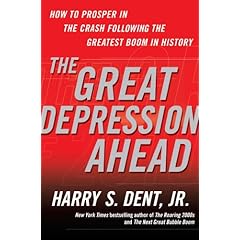
Book: The Great Depression Ahead: How to Prosper in the Crash Following the Greatest Boom in History - Part II

The Great Depression Ahead: How to Prosper in the Crash Following the Greatest Boom in History
By Harry S. Dent

I blogged about this book when I began reading it the other day.

Since then I finished reading the book, attended a lecture by the author, and discussed his ideas with others at some length.

Dent's premise is that economies are people spending money and that economic performance can be predicted based on how many people are in the economy, how old they are, where they live, and what they are buying. And the last two are largely dependent upon the first two.

So he believes that the United States baby boom population has now moved beyond the peak in maximum spending. He bases this on statistical research but also offers several possible reasons to explain it including the need to save for retirement, fear of economic uncertainty, downsizing, adopting slower life styles, and so on.

As an example he discussed the statistic that people buy their largest house at age 41. The friend and I who attended the presentation looked at each other and smiled because we were both that age when we built our largest homes. Dent showed a graph that plotted the age of Harley-Davidson buyers and it startling how sharply the graph shot up and just as sharply shot down.

I don't really like learning that my own buying habits are so predictable. I like to think of myself as being unique. And, yes, it is nearly hysterically funny that all of my group believe themselves to be just as unique. So even in that we are the same!

Now since all these baby boomers are now spending less and saving more it stands to reason that all the stuff we were buying is going to also decline unless someone else comes along to buy the same stuff.

But the people that will come along and will buy at least some of the same stuff are about 20 or more years away. And since they are our kids they will not buy exactly the same stuff as their parents just as we did not buy the same stuff bought by our parents.

So in Dent's discussion the good part is that there is another group coming up behind us in the United States. That's because our immigration adjusted birth rate is about 2.1 children per family. He says that is about the minimum to keep things as they are.

That's not true in Europe where rates range from as low as 1.3 to 1.7 or 1.8 per family. So in Europe there is no future population bubble and that means, according to Dent, that those economies are permanently declining. Japan is the same except even further along because in Japan there was no post World War II baby boom.

China is behind the United States according to Dent by about 10 years. They would be in much better shape except that about 20 years ago the government mandated that families must not have more than 1 child. Dent predicts this will eventually lead to a declining economy there as well.

India and other emerging nations around the world including several in South America will continue to have growth.

What all this means more specifically in the United States is that our present recession will turn into a major deflationary depression after a short recovery in the next year or so. That deflationary depression will last until about 2012 according to Dent.

Deflation is where the price of things continues to decline. Dent predicts that home prices , for instance, will decline to about the level they were in 1987 or 1988. In some areas that is a massive decline. In my area it is not so much because our property values have not bubbled up as much as in California or Florida and other places.

He believes everything will deflate including all commodities. And, yes, he does think gold will fall as well as everything else. Near term - next 18 months maybe - gold and oil and natural gas and some others are likely to increase. But afterward they are likely to fall is his prediction.

How far will they fall? Well he thinks oil may fall below $20 per barrel. That's really bad news for my area although that's about what oil cost in 1998 when I came to live with my Mom and Dad.

Dent believes that unemployment is likely to reach nearly 15% before it begins to decline.

Someone asked Dent in the question and answer session following his speech if he had presented this material to our president and congress. He said that many of them were aware of his ideas but that generally he was not well received by politicians. The reason he explained was that they concluded from his remarks that political action was largely irrelevant in relation to changing our economy. He said politicians do not like to think of themselves as irrelevant in anything. Moreover their constituents certainly do not like to think of them as irrelevant and demand action.

Now the $64,000 question (which I guess now might be $64 Trillion) is what do I think about Dent and his ideas.

I've thought a lot about what I think about him. And I've reached a conclusion.

I think his statistics are accurate.

I think his premise is probably correct.

But I think there are a couple of problems I see with his conclusions and predictions.

People can surprise you for one thing. They can act predictably for 50 years and then all of a sudden do some of the strangest things. That's especially true when there is stress. Sometimes it is good and sometimes not.

Then there are external circumstances. Dent tries to account for some of these. But I think the problem is that it is simply not possible to know them all.

So I do think there is going to be some deflation and I think the recession is going to be worse than anyone wants it to be.

Tuesday, February 10, 2009

Book: The Great Depression Ahead: How to Prosper in the Crash Following the Greatest Boom in History

The Great Depression Ahead: How to Prosper in the Crash Following the Greatest Boom in History
By Harry S. Dent

Harry Dent was born in 1950 so he's a couple of years younger than my age. He was born in Berkeley but received his B.A. from the University of South Carolina and later an M.B.A. from Harvard Business School.

He wrote his first book in 1969. It was titled "Our Power to Predict." And predicting is pretty much what he's been doing since with 6 more books, consulting, speaking, newsletters, and what not.

Predicting the future is fraught with problems as most of us have also experienced first hand. Predicting future economic trends is certainly no less susceptible. And several of my readers will remember that my political predicting success rate is as low as it is possible to achieve - or not achieve that is.

Iin 1998 Dent wrote this book called "The Roaring 2000s" and in 1999 another called "The Roaring 2000s Investor." You know like "the roaring 20's." He predicted a DOW of 32,000 back then and later revised that to 16,000. Well the DOW managed to get to 14,000 finally.

So because of that prediction and because now he's predicting a major deflationary depression, Mr. Dent is not very popular with stock broker and investment adviser type folks. Nor is he popular with folks who depend on the investment community. That's a pretty big population.

Dent's most basic underlying principle is that economies are comprised of people spending money and the most important facts about those people are: 1) how many of them there are; 2) how old they are; 3) what they buy; and, 4) where they live.

By way of example he writes that the age when adults buy the most potato chips is 42. He further analyzes this by stating that the average age of marriage is 26 and the average age of having the first child is 28 and 14 years later that child is at the peak food consumption age. And that coincides (but not coincidentally) with the peak in buying potato chips.

Since it is possible to predict some of these macro patterns of human behavior he concludes that it is therefore possible to predict economic consequences of that behavior.

In addition to this he believes he has discovered several great cyclical patterns over long periods of time and associated with large groups of humans. He believes there is a civilization cycle and a technological cycle and a geopolitical cycle and a few others.

What I find interesting is that he was able to predict the occurrence of a technological boom that roughly coincided with the Internet boom. He did that without knowing or even trying to predict what would drive the boom. Or in other words he had no idea bout the Internet. He just predicted there would be some kind of new or improved technology that would drive economic production.

That's a pretty amazing idea to me when I stop and think about it. So I can sit here in Starbucks and think that in the next 20 or 30 or 50 or whatever years there is going to occur another technological boom. I don't know what it is going to be but it is going to drive human productivity.

I think I've always had a kind of nebulous idea about something like this happening. But what is different and new is the idea that this is actually cyclical and predictable.

Do I believe that? I don't know. At first I dismissed it entirely. But the more I think about it and the more I read Dent's thoughts about it the more I am willing to consider the idea.

On the other hand sometimes coincidences are just coincidences, too.

Mr. Dent makes it sound like he was very accurate in predicting recent events. That's recent in the past 20 years or so. His critics make it seem he was not accurate at all. My conclusion is that Mr. Dent makes his own case seem better. But would we expect anything else from someone who makes his living on predicting? On the other hand his critics hardly are objective and have their own problems with the advice they've handed out.

Let's face facts. Everyone who is in the financial business is making some kind of prediction. That's even if it is the idea that one should invest in good companies for the very long haul as Mr. Buffett. And he's 78.

I think Dent raises very good points about the changing demographics in the United States, i.e., the changing age of that potato chip buyer. I further think he is probably correct about certain things he predicts even though he may miss some numbers and some dates.

If you can predict numbers, dates, and events then you are a prophet. He doesn't pretend to be a prophet either.

I'm going to write more about Dent over the next few days.